
My Journey to Permanent Residence in Japan — and What Has Changed Since 2001
I’ve been a resident of Japan for (gulp) more than half my life. And I’ve been a permanent resident for about 25 years now. There are changes coming to the PR (permanent residency) application system, and many people who are trying to make a life here are concerned. I feel fortunate things were apparently simpler back when I applied. Then, the process seemed to have been fairly straightforward and lenient.
As of the end of last year, 947,125 people held permanent residency status, according to Immigration Services Agency data. You read different reports on the newer rules and from what I’ve been reading, the newer rules include longer prior residency permissions when applying, higher income than the average Japanese income (a big roadblock for many), a high level of Japanese language proficiency, much higher application fees, and requiring perfect tax, health insurance, and pension compliance. With all the changes, I hope things go well for a few friends who are hoping to obtain permanent residence.
In my case, I came to work on a computer graphics project for Expo ’85 in Tsukuba. See 40 Years in Japan – a Warm, Nostalgic Party – Thank You! To tell the truth, I had not really given Japan much thought before being invited to join the project when I was a grad student at Lawrence Livermore National Labs. My professor was in charge of the project, and I was just tagging along. I bought a copy of “The Japan Handbook” to try to catch up, and submitted the paperwork provided by the Japanese company to the consulate in San Francisco,
Cute side note about submitting the paperwork at the consulate
There were lots of pages and the woman at the consulate counter went through each one carefully. She paused at one point and said a signature was missing! I sighed, “So I have to send this all back to Japan to get it fixed?” She gave me a serious look and said, “All I’m saying is that we need a signature that looks like the one you see there on that page here on this page.” She handed me the papers and waited while I went to the counter and made sure that happened. She took the papers back and nodded in approval and said it all looks good.
I thought, “Japanese seem like reasonable people. I’m going to get along with them.”
Moving to Japan and my residency history
After a couple of months the visa came through and I packed up and flew over. I learned to count from one to ten in Japanese on the plane, thanks to a kid sitting next to me who was excited to teach me all about Japan.
Getting back to my residency history, I arrived in Japan in 1983 on a one-year work permit. For a number of years I returned to the Immigration Bureau each year to renew my status. Each year I’d visit one of the immigration offices, usually the one in Shibuya, if I remember correctly. There was also one in Kabukichō, near Shinjuku Station. Both were easier to get to than today’s centralized Immigration Bureau in Shinagawa. At the time I was living in Hōnanchō in Suginami-ku, so I usually rode my 50 cc scooter to the immigration office in Shibuya. It was a fairly easy trip. Today’s centralized office in Shinagawa is much farther away and considerably less convenient.
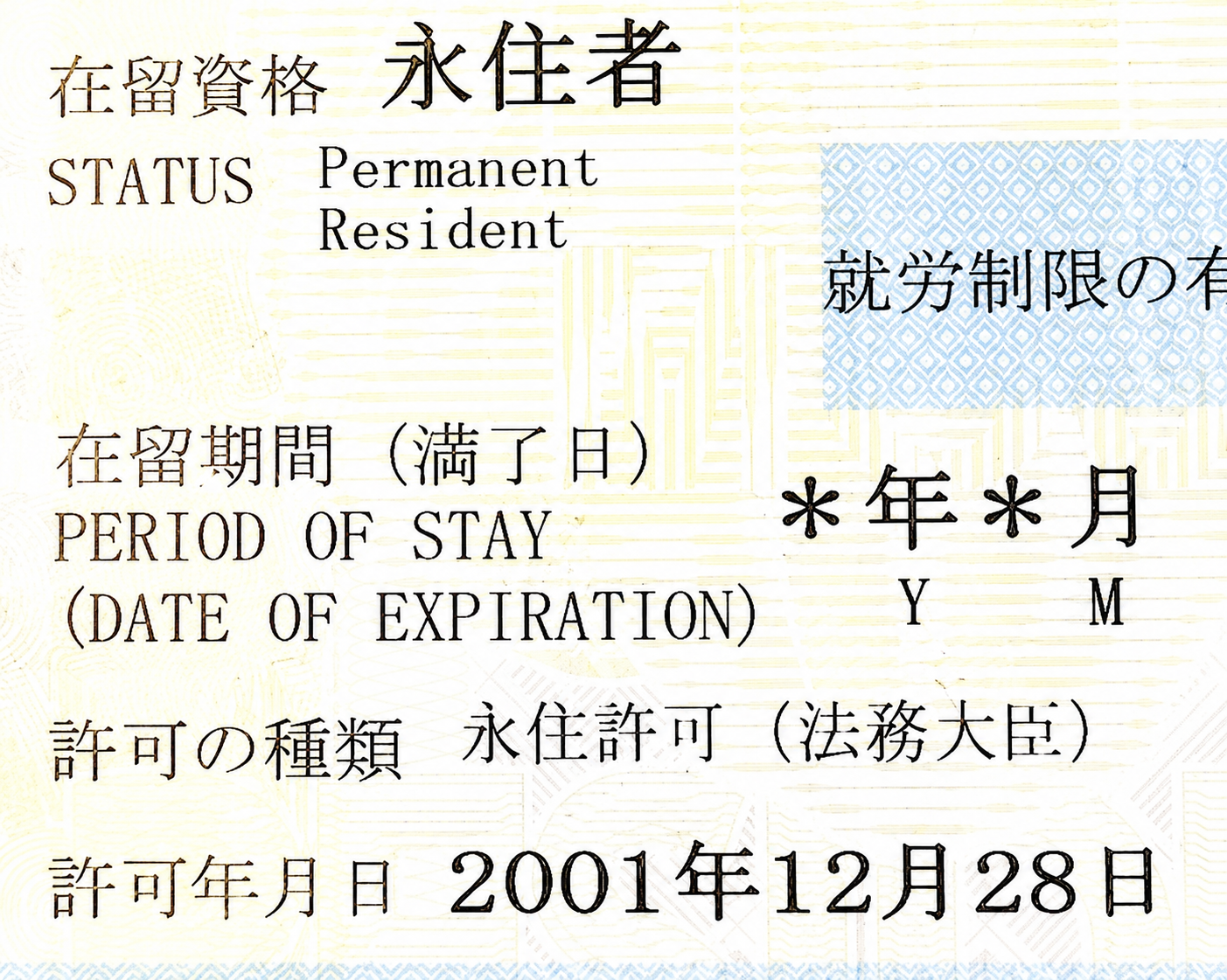
Eventually, the Immigration Bureau upgraded me to a three-year period of stay as a Long-Term Resident (定住者). I no longer remember exactly when that first happened, or exactly why, but by October 1998 I see in an old passport that I definitely been granted a three-year long-term resident status. When I returned in 2001 to renew that once more, the immigration officer suggested I apply for Permanent Residence instead. He seemed to think I qualified. To ensure I remained in legal status while my application was being reviewed, they issued me another three-year extension. My Permanent Residence was approved just two months later, on December 28, 2001.
Here is a photo from my old passport showing the permanent residence sticker approved in December, 2001. I’ve removed some numbers, though they probably don’t mean anything anymore. And, in fact, residence status in passport stickers aren’t used anymore.

Immigration and Resident Rule Changes over the Years
Over the years rules about stickers, ID cards, and other things have evolved.
Before 2012: Permanent residence (and other statuses of residence) were evidenced by stickers or endorsements in the passport. Foreign residents also carried an Alien Registration Card (外国人登録証明書) issued by their municipality.
July 2012 onward: The Alien Registration Card was abolished. The Residence Card (在留カード) was introduced. Status of residence — including Permanent Resident (永住者) — became recorded on the residence card rather than by a sticker in your passport.
Today: Your passport is simply your travel document. Your legal immigration status is shown on your Residence Card.
Getting Back to My PR Application
The Immigration Office was very cooperative and seemed interested in getting it done. I ran into a couple of issues that needed resolving. For example, I apparently had not properly filed municipal taxes for a few years. But they just sent me to the tax office where I settled up (I think it came to about 80,000 yen) and they gave me government-sealed documents proving I was ok. I hear with the new rules they are less forgiving.
Also, the paperwork required a government issued birth certificate from the U.S. But my application was submitted in October, 2001. A month after 9/11. And I was born in New York City. The city office that handled birth certificates was still shut down, but the Immigration Office accepted a written statement from me accepting that.
And in December, 2001 I became a permanent resident.
Life in Japan Since Becoming a Permanent Resident
I have to admit I was excited by the new status.
Looking back now, it’s strange to think how much anxiety those annual renewals caused. Each year I wondered whether everything would go smoothly and whether another year’s permission would be granted. Becoming a permanent resident removed that uncertainty. For the first time, Japan truly felt like home rather than simply the place where I happened to be working.
I felt appreciation for all the acceptance I received over the years — at work, and with all the friends I made. Previously I would (half) jokingly tell family and friends in the U.S. I had not returned yet, “because I hate packing.” But I began to feel like I belonged here even more. I remember visiting a government office anxious to do some volunteer work. They set me up to help out at an “Ecology Fair” they were holding that year. I’ve also enjoyed other volunteer work over the years, including weekly support for Hibikinokai and my volunteer days at the Tokyo 2020 Olympics.
I remain a U.S. citizen and have no desire to change that. I vote in U.S. elections. But I deeply appreciate many things about Japan that I wish would get adopted by the U.S., like universal national health insurance with premiums based on income, reasonable co-pays, and maximum spending limits while still maintaining lots of choice and private hospitals and clinics. Japan simply feels safer and healthier to me.
Plus I have a husband here — check out our two year anniversary, and a home, and (sigh) Pao — check out our recent visit to the dog run — who is finally resting after a frantic day yesterday when I took him at night to the pet clinic. But that’s a story for another day.
Comments
My Journey to Permanent Residence in Japan — and What Has Changed Since 2001 — No Comments
HTML tags allowed in your comment: <a href="" title=""> <abbr title=""> <acronym title=""> <b> <blockquote cite=""> <cite> <code> <del datetime=""> <em> <i> <q cite=""> <s> <strike> <strong>