America is a land of immigrants

This post doesn’t have an abundance of legalese. I’m not a lawyer. And I will only touch the surface on things like the history of immigration, permanent residency, and birthright citizenship. But with all everything in the news lately, and the recent case before the Supreme Court on the standing of the 14th Amendment, I wanted to write about something close to me that’s personal.
Ever since I was a child I have always been taught, and always felt, that America is a land of immigrants. That’s what makes America special, strong, and great. In fact, all four of my grandparents were immigrants – from Poland and Russia. Their timing was good. They got in before harder restrictions became law in the 1920s. It’s been an up-and-down thing in America’s history. There was a time when Chinese and Japanese were excluded. There was even a time when Native Americans were denied citizenship! There is a long history of racism in American citizenship and immigration laws. The 14th Amendment helped of course. But additional laws passed by Congress were needed over the years. And things are still far from perfect. Racism in immigration seems to come and go in cycles over time.
But flexible immigration and birthright citizenship have been good for America. Cutting back on either or both risks hurting America in science, medical care, technology, and labor. We are already seeing that happening with needed doctors disappearing from rural areas because of harsh new visa rules.
My grandparents came, and they thrived, and they contributed to the community and economy. My parents were born in New York, and my sister and I were born in New York, and I am grateful my grandparents embarked on their voyage to the U.S. so many years ago. Yesterday would have been my mother’s 99th birthday.
Here’s Grandma Alice’s certificate of citizenship, from 1940. As best I can tell, Grandpa Joseph, my mother’s father, gained citizenship in 1928. My mother was born in 1927 – before either of her parents became citizens.So she had birthright citizenship. Nobody has ever questioned that.
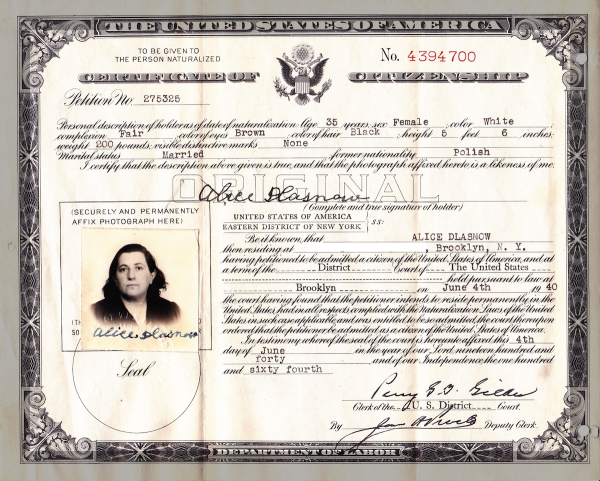
There were no green cards when my grandparents arrived at Ellis Island in New York. Those came with the Alien Registration Act of 1940, which required all non-citizen residents to register and be fingerprinted. I suppose it was not a coincidence that it was 1940 when Grandma Alice decided to formally certify her citizenship.
In 1927, they were considered legally admitted immigrants with the right to remain permanently. They were able to work, own property, and raise a family. Despite the relative lack of paperwork, there was no question that their children were U.S. citizens.
Before 1921 the doors were relatively open. Immigration from Europe was largely unrestricted. You just needed to pass a health inspection at Ellis Island and not be deemed a public charge. Millions of Eastern European Jews came through this way, especially in the years 1880–1920.
Things changed dramatically starting in 1921. There was an Emergency Quota Act of 1921 which suddenly capped immigration by nationality. And the Immigration Act of 1924 (Johnson-Reed Act) made it much stricter, setting quotas based on the 1890 census, which heavily favored Northern/Western Europeans and severely restricted Eastern Europeans, including Poles and Jews. So my mother’s parents arrived just in time.
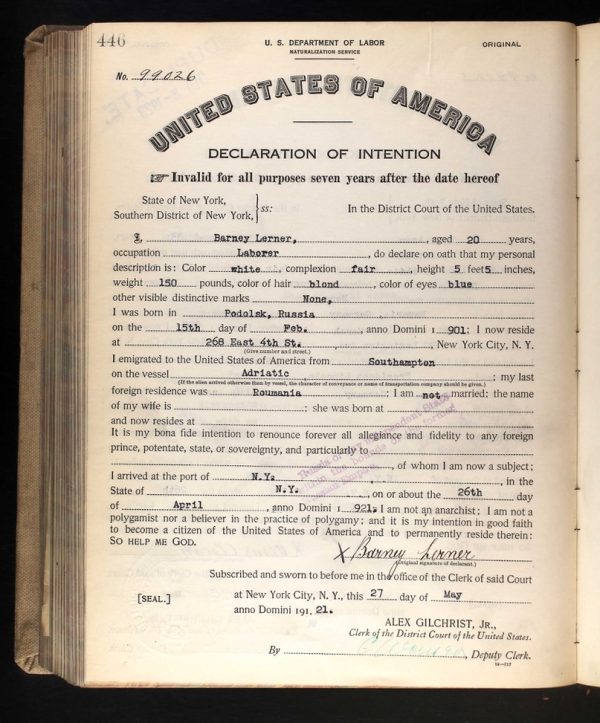
It’s the same on my father’s side of the family. As best I can tell, my father’s father, Barney, arrived in 1921 and signed a declaration which stated, “1 am not an anarchist: 1 am not a polygamist nor a believer in the practice of polygamy; and it is my intention in good faith to become a citizen of the United States of America and to permanentiy reside therein: SO HELP ME GOD.” I don’t have details on when he was actually naturalized. Nor do I have details on when my father’s mother, Rose, was naturalized. But I think it must have been similar to my mother’s parents.
Note: In addition to some old documents I found, I have been looking things up at familysearch.org, which is a non-profit, free site run by the The Church of Jesus Christ of Latter-day Saints. They don’t discriminate based on traditions, culture, or religious affiliation and have millions of records. It’s interesting to look through and search.
Here’s Grandpa Barney’s Declaration of Intention from 1921, shortly after arriving in the U.S. from Southhampton on the vessel Adriatic.
Anyway, all four of my grandparents were immigrants in the early 20th century. Both my parents were U.S. citizens by birthright citizenship, as stated in the U.S. Constitution. And because of that my parents, my sister, and I grew up as citizens of the U.S. Nobody has ever questioned this.
I’m in favor of more open immigration, permanent residency, and citizenship laws. I don’t want to be the sort of person who figures, “I got mine, so who cares about everybody else?” Plus I think it benefits everybody in the long run. It’s good for America. And it benefits the whole world.
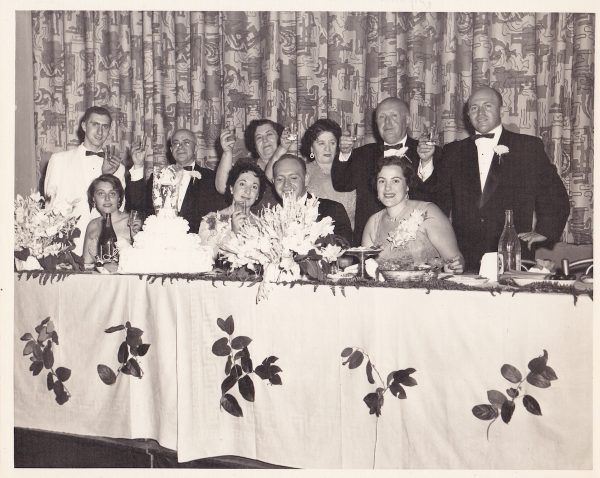
Here is a photo from my parents’ wedding day, in 1955. In the front row, left to right, are my Aunt Bernice (my mother’s sister), my mother, my father, and my Aunt Bea (my father’s brother’s wife). In the back row, left to right, are my Uncle Al (Bernice’s husband then), Grandpa Joseph, Grandma Alice, Grandma Rose, Grandpa Barney, and my Uncle Murray (my father’s brother).
All here because Grandpa Joseph, Grandma Alice, Grandma Rose, and Grandpa Barney decided to emigrate to America. And because America is a land of immigrants. And that’s what made America great.
Thanks for sharing your family’s history, Doug. That was interesting.